Starting February 17, 2015, you’ll be able to order coconut milk for your favorite Starbucks beverage.
Starbucks has been testing coconut milk as a dairy alternative for about one year. It began as a small test in the Portland, Oregon stores. By summer 2014, Cleveland, Ohio Starbucks stores added coconut milk. All the gossip I heard was that there was a good response from customers. Starbucks customers want non-dairy milk alternatives. By October 2014, Starbucks (in an official Starbucks blog post) indicated that coconut milk was doing well, and that Starbucks expanded the test to Los Angeles locations.
At this point, it’s hardly a secret that coconut milk will be nationally available in the U.S. beginning the 17th of this month. If you look at Instagram (using hashtags like #tobeapartner) you’ll find these green boxes of coconut milk popping up everywhere. It’s in stores now for partners (Starbucks calls their employees ‘partners’) to try, however will not be available for customers until the 17th.
What do you think? Are you going to start order coconut milk lattes, mochas, and Frappuccinos? I myself still drink dairy, but having said that, I fully recognize that there is a huge demand for non-dairly products such as soy milk, coconut milk, or even almond milk (almond milk is not available at Starbucks). By the way, if you are visiting the Starbucks Reserve Roastery and Tasting Room, coconut milk is available now as a milk option.
Alibaba Drones Fly Over Beijing as Amazon Seeks U.S. Test
Remote-controlled helicopters are expected to distribute 50 parcels from Alibaba’s Taobabo Marketplace in Beijing Wednesday, before moving to Shanghai and Guangzhou.
(Bloomberg) -- Alibaba Group Holding Ltd. is making its first trial drone deliveries in China, as e-commerce rival Amazon.com Inc. struggles to start a similar program in the U.S.
Asia’s largest Internet company is partnering with Shanghai YTO Express Logistics Co. to deliver ginger tea packets to 450 Chinese customers who volunteered for the one-time drone tests, according to an e-mailed statement from Alibaba. Remote-controlled helicopters are expected to distribute 50 parcels from Alibaba’s Taobabo Marketplace in Beijing Wednesday, before moving to Shanghai and Guangzhou.
The flights, if successful and uncontested by authorities, would give the budding commercial drone industry a boost in China, where the military allots only a fifth of the airspace to civilian use. Amazon -- the largest Internet retailer by sales - - has begun testing remote deliveries abroad after asking the U.S. Federal Aviation Administration to speed approvals for drones tests in Washington state.
“China is still in the initial phase of establishing regulations on commercial usage of drones, a lot of areas are still completely blank,” Zhang Qihuai, an attorney at the Beijing-based Lanpeng Law Firm, said by phone. “Key regulations regarding flight altitude, accountability for accidents have not been established yet. There’s still a long way to go before drone can really be commercial used in China.”
Alibaba and YTO said they have notified Chinese aviation authorities about the flights as required by regulation and believed that the deliveries complied with all existing rules.
Licensed Pilots
At least one of the drones was expected to fly from YTO’s warehouse in the eastern outskirts of Beijing and reach the 330 meter (1,100 feet) China World Trade Center in less than an hour. A deliveryman will await the parcel’s arrival on the ground floor and carry it to customer, Jia Yun, a Taobao spokeswoman, said by phone from Beijing.
The Civil Aviation Administration of China issued regulations to 2009, requiring operators of drones to be identified when applying to use such devices, according to a posting on the agency’s website. Chinese regulators are considering license requirements for drone operators, a step the FAA is also discussing for unmanned commercial flights.
Two calls to the Civil Aviation Administration’s public affairs office went unanswered.
YTO has no specific plans to promote drones on a larger scale and lot of issues must first be addressed, said Ren Xue, the company’s Shanghai-based spokesman.
White House
U.S. moves to restrict commercial drones have frustrated Amazon’s plans to fly light packages to customers in 30 minutes or less. Drone use in the U.S. was dealt another setback last month after an operator lost control of a SZ DJI Technology Co.- built quadcopter and it crashed on White House grounds, according to the Secret Service.
U.S. President Barack Obama later stressed the importance of rules to ensure drone safety.
The Shenzhen, China-based SZ DJI accounts for more than half the mini drones sold globally, the official Nanfang Daily reported Tuesday. Xue declined to say what company made the drones used in the Alibaba flights.
Tuesday, February 3, 2015
Ignore Ocado's profits — here is the really important bit in today's earnings statement
Ocado recorded its first annual profit in 2014, and that is making a lot of headlines: The company booked a pre-tax profit of £7.2 million and the business press is going bananas over it.
The sudden appearance of money on Ocado's bottom line is news because (until yesterday) as everyone "knows," Ocado doesn't make profits! And maybe it cannot make profits! And therefore it is doomed!
That's the mantra that surrounds Ocado, driven largely by analysts who compare it to the supermarkets it competes with. The problem is that Ocado is not a supermarket, it's a mobile shopping app, and unless you see it as such you will continuously underestimate what this company is going to do.
The profit is largely irrelevant to the overall direction of Ocado's business, because Ocado operates the same way Amazon does: It spends all its profits immediately on growing its business. For this reason it is usually unprofitable. And for this reason its revenues are always growing. It is a growth company, not an earnings-per-share company.
Here are the two most important things we heard from CEO Tim Steiner's results presentation today:
Revenues grew nearly 20% to nearly £1 billion. Yep — Ocado is now a £1 billion British food delivery business. That's amazing. No other major supermarket in the UK is growing like that. They are all in decline. Ocado is smaller, sure, but check back in a few years. It will be slicing market share from Tesco, Waitrose et al. at these growth rates.
Steiner confirmed he is about to do a deal to expand the company internationally. "I can't tell you exactly when it 's going to happen," he said. But the company is having a number of conversations with other companies and "we are targeting to turn one into a deal in 2015 that will go live later than that."
So it looks like Steiner is about to spend all that profit on yet another expansion of the company. Again, note that the profit here might indeed be temporary if Ocado uses it to fuel a deal elsewhere.
Business Insider noted recently that Steiner had previously met with Amazon CEO Jeff Bezos. Steiner talked about Amazon in his presentation today, too. He was asked whether he was worried about Amazon's Amazon Fresh grocery service arriving in the UK.
"I'm not concerned. We have really fierce competitors here in the market today. ... We welcome competition."
Well, sure. But it's interesting that he even mentioned the word "Amazon" given that Amazon isn't even operating in the UK. He's either very sure that Bezos believes it would be difficult to compete against Ocado at this late stage, or he is hoping in some way to attract Amazon's attention.
That last possibility is enticing because Ocado is exactly the type of company that Amazon has historically acquired.
Monday, February 2, 2015
German grocery store doesn’t waste, rest of food industry should follow suit
In Berlin, Germany, storeowners Sara Wolf and Milena Glimbovski have crowdfunded a revolutionary project that dares to accomplish the “impossible.”
The two women established a grocery store - Original Unverpackt [Unpackaged] - and sell upwards of 350 different products that are dispensed from refillable containers, while some of the liquid commodities come in bottles with individual deposits. What makes Original Unverpackt special is the fact that the unique dispersion system creates zero waste. The costumer is able to cater to his or her needs, purchasing only what is needed - thus creating less waste at home, as well.
Today, grocery stores offer products that are sold in brightly colored, attention-grabbing packages that are designed to appeal to customers.However, Wolf and Glimbovski recognize that this kind of marketing only leads to waste and they firmly believe that package-free groceries are the answer.
At Original Unverpackt, many of the food products are placed in gravity-storage receptacles – the same way that many candy stores have operated for years.Customers supply their own containers from home and are able to purchase exactly how much they need. Fresh fruits and vegetables are left unpackaged and products such as pasta, cereal and cheese are kept in cellophane-free packaging or glass jars.In the event that someone forgets their canisters or bags at home or decides to do some spontaneous shopping, Original Unverpackt has containers and recycled paper bags available for purchase.
Wolf and Glimbovski have also worked closely with health authorities during the development and launch of the store, so all processes are strictly hygienic and safe for consumers. As a college student, this type of store strongly appeals to me because food waste is an area that I strive to improve upon in my own life.Just night, I threw away about a third of a loaf of bread because I didn’t eat it fast enough and it grew moldy. Unfortunately, food waste is an issue for many other Americans, as well.
According to the United States Environmental Protection Agency [EPA], only 4.8 percent of food products were recovered from the initial 36.43 million tons that were produced in the United States in 2012. Sadly, 53.80 percent of our municipal solid waste [MSW] was also discarded completely. As for plastics, 31.75 million tons were generated, while only 2.80 million tons were recovered [an 8.8 percent recovery rate.] Similarly for paper and paperboard, 68.82 million tons were generated and 44.36 million tons were recovered [a 64.6 percent recovery rate.] The recovery rates for glass and all metals was 27.7 percent and 34.0 percent,respectively.
As you can imagine, grocery stores use and supply all of the aforementioned products: plastic, cardboard, glass, metal and, mostimportantly, food. Although Original Unverpackt is the first of its kind and the Berlin location is merely a pilot store, I think that this project has the potential to send the message to the rest of the food industry that alternative methods of operation are both feasible and worth the effort - and that the current method of grocery shopping is not sustainable.
John Mackey, the co-founder and co-chief executive officer of Whole Foods Market, is making for the produce section of his 80,000-square-foot flagship store in Austin, Texas. He walks with a slight limp, the result of osteoarthritis in his hip after years of jogging and basketball, so it’s easy for customers to recognize him and chat him up.
One, clutching a ground beef and veggie taco lunch, tells him he’s been shopping at Whole Foods for three decades. “You don’t look old enough to have eaten here for 30 years,” says Mackey. He stops by an elderly woman picking through a container of pink lady apples. “These are not organic, but I happen to know for a fact the grower does incredible things in the way they take care of the soil,” he tells her. Other customers turn to each other and whisper as Mackey passes. The fishmongers and meat cutters behind the counter call out his name.
Mackey is the graying heartthrob of mindful groceries. Over the past 37 years he’s helped popularize the notion that Americans should devote more thought—and money—to their food. He took what had been a college town’s alternative grocery, with bins of grains and lentils, wilting veggies, and biodegradable soaps, and built a high-margin supermarket chain with almost 400 stores in 43 states and $14.2 billion in annual revenue. On the strength of its share price, Whole Foods briefly became the second-most valuable food retailer in the U.S., behind Wal-Mart Stores, in the fall of 2013. But Whole Foods, unaffectionately known as Whole Paycheck, had a lousy 2014. Same-store sales growth fell from 8 percent to 4 percent, and its share price tumbled 10 percent. Meanwhile, competition is squeezing Whole Foods like an organic lemon over a bowl of quinoa.
On one side are traditional chains such as Kroger, Safeway, and Wal-Mart, which have rushed to add soy crackers and $5 half-gallons of organic milk to their shelves. On the other are fast-expanding regional and national grocers catering to Land Rovered cosmopolites—Sprouts Farmers Market, Fresh Thyme Farmers Market, and Trader Joe’s, the last of which spread to Colorado, Florida, and Texas in 2013 and 2014. These chains offer grass-fed beef and probiotic yogurts as well, and the additional locations are carving up Whole Foods’ once-devoted customer base.
Mackey is in the awkward position of having to explain why Whole Foods can thrive in the very world he created. Which is why he’s eager to tour the fruit and vegetable aisles of his Austin store. Dangling over the displays are a series of SALE! placards in red letters. The company was once reluctant to compete with rivals purely on price, but here are signs proclaiming that organic broccoli is marked down to $1.48 a pound and two boxes of Driscoll blackberries are $3. Mackey points out a sign across the aisle: The seedless navel oranges and green kale are “responsibly grown.” The produce gets ratings—good, better, and best—based on farmers’ records in water conservation, worker safety, and other metrics. Some goods at Whole Foods cost more, and he wants to tell you why. “Look at where your eye goes when you walk into the store,” Mackey says. “We are now going to make sure we tell customers what we are about: values and value.”
Co-CEOs Robb, left, and Mackey at the Whole Foods flagship store in Austin
Photographer: Ryan Lowry for Bloomberg Businessweek
A libertarian with a hippie streak, who rails against creeping nanny-statism (Obamacare, minimum-wage laws) and the soullessness of corporate America, Mackey is challenging some of his own cherished beliefs. He’s down with advertising now. For the first time in Whole Foods’ history, the chain is running national ads: It’s spending $15 million to $20 million on a campaign that features rugged-looking farmers and fishermen vowing that “values matter.” And the company’s finally using one of the oldest tools in the supermarket toolbox, which Mackey resisted for years: a loyalty program.
It’s too early to determine how these changes will play with consumers, but at least one constituency is enthusiastic: the competition. “They’re becoming more and more like a traditional grocer,” says Rob Spiro, the CEO of Good Eggs, a Silicon Valley-based organic food delivery service, who says there’s now room for other companies to forge strong bonds with foodies. “They aren’t at the forefront of food consciousness in the way they were four or five years ago.”
In 1978, Mackey opened Safer Way Natural Foods, his first health food store, on an Austin city block about a half mile from Whole Foods’ current headquarters. The tiny store, which he founded with his then-girlfriend and $45,000 borrowed from family and friends, didn’t stock meat, sugar, coffee, white flour, or alcohol. “It was a pure store,” Mackey says. “And it didn’t do any business.”
Mackey eventually merged Safer Way with a crosstown rival, renamed it Whole Foods, and moved to a larger space inside a former nightclub. Although his personal tastes have remained health-conscious—he went vegan 11 years ago—pragmatism caught up with earnestness. The stores began to sell duck confit and rib-eye steaks, and Mackey scandalized purists by stocking gluten-free cheesecakes and other heretical but profitable products. “We never wanted to be holy foods market,” he says. “We want to be a one-stop grocery store.”
Mackey proved that people would pay extra for food if it was plausibly earth-friendly. So there are no Doritos or Coca-Colas, but you’ll find fair-trade chocolate bars and cranberry kombucha. Whole Foods opened hundreds of stores from 1990 to 2014, in part by snapping up regional health food chains, and attracted a zealous workforce inspired by its mission of bringing healthy food to the world. Cities competed for stores; shoppers competed for parking spots.
Photographer: Andrew B. Myers
The company knew only good times until late 2007 and the global financial crisis. As even well-heeled shoppers started looking for discounts, same-store sales growth went negative for the first time during its 2009 fiscal year, and the stock price fell from $30 to $4 a share. Wall Street analysts condemned Whole Foods as a high-cost operator that couldn’t compete in tough times and wondered whether it had the capital to ride out the recession.
Walter Robb, Mackey’s operationally minded co-CEO, calls the Great Recession the company’s first “crucible moment.” At the time, Whole Foods was highly decentralized, with regional managers making decisions on merchandising and prices while getting rewarded for quarterly financial performance. The system motivated them to keep prices and profits high, particularly in markets without local competition from other health food retailers. That reinforced the Whole Paycheck image—a nickname that the company improbably claims started out as praise from a devoted customer who said he felt tempted to empty his bank account at the store. “A lot of consumers still think of Whole Foods in that way, as an elitist store that isn’t within their reach or even a place where they want to shop,” says Carlotta Mast, executive director for content and insights at New Hope Natural Media.
As the economy recovered, so did Whole Foods, posting some of its best years. Its stock price rose to $60, and in the fall of 2013, its market capitalization exceeded that of Kroger, the 130-year-old giant that operates more than 2,000 stores. The visible trend toward healthy, natural foods sparked a new wave of competition. Fresh Thyme, backed by $50 million in private equity, started an aggressive expansion across the Midwest. Sprouts, a Phoenix-based grocer with an emphasis on smaller stores and cheap produce, had one of the biggest initial public offerings of 2013. It’s now in 11 states.
At the same time, traditional supermarkets, noticing that shoppers were losing their taste for processed foods, scrambled aboard the healthy foods bandwagon. “Everyone seemed to realize at the same time that the market was tipping,” says Robb.
Suddenly it became clear that Whole Foods was vulnerable. In a terrible earnings report last May, the company cut its same-store sales and earnings forecast for the third time in 12 months; the stock fell 15 percent. The next day, Whole Foods’ management council of seven executives, dubbed the “e-team,” met in the company’s sixth-floor conference room in Austin and agreed they hadn’t done enough to prepare for the competition. “We were no longer relevant,” says Robb. “John and I were the stupidest guys around.”
Mackey and Robb have one of the most unconventional partnerships in American business. Robb sold his Mill Valley (Calif.) supermarket to Whole Foods in 1991 and, with Mackey’s support, was promoted to co-CEO in 2010 after getting offers to lead other companies. The pair now describe themselves as equal partners, with each involved in running the business and guiding the long-term vision.
They share a fashion sense one might call “free-range businessman”—crosshatched button-downs with earth-tone undershirts and loafers. Robb awkwardly describes the partnership as “marriage without the sex.” Informed of that metaphor, Mackey says, “Walter and I have a platonic relationship,” then thinks for a moment. “That would be a hot scandal, wouldn’t it?”
In separate interviews, the co-CEOs give different reasons for the growth slowdown. Mackey says it was primarily the result of Whole Foods’ own aggressive expansion. New locations drew customers from older stores, a situation that should have corrected itself as the entire market grew. Robb argues that the company had fundamentally underestimated the speed with which all of retail was changing and natural food was becoming ubiquitous. “All of a sudden there was the narrative that you can get the same stuff in many other places and you could get it for cheaper,” he says.
Photographer: Andrew B. Myers
Mackey likes to quote economist Paul Romer’s line that a “crisis is a terrible thing to waste” (though, like others, he attributes it to former Obama Chief of Staff Rahm Emanuel). The challenges of 2014 offered him a chance to shake up his company. But one of the first opportunities involved shedding his disdain for traditional advertising.
Mackey hates phony, hard-sell marketing. Meetings with various ad agencies over the years typically went badly, after they opened their pitches with research suggesting Whole Foods should start selling mass-produced brands such as Diet Coke and Oreos. Robb changed Mackey’s mind by bringing in the New York branding agency Partners & Spade, which has done lauded work for such companies as Warby Parker and Shinola, a luxury watchmaker with a side mission of reinvigorating Detroit’s business community. Fresh off the May earnings debacle, Robb invited the firm’s co-founder, Anthony Sperduti, to present to the e-team.
Mackey admits he had “a bad attitude” going into that meeting, but he says Sperduti impressed him by declaring off the bat that he hadn’t done any market research and that he prefers to tailor messages from instinct and his personal knowledge of brands. “Most CEOs might view it as a negative,” Sperduti says.
Partners & Spade then spent a few months collaborating closely with the e-team, whose members expressed an unusual interest in controlling just about every sentence in the ads. Mackey and his colleagues ruled out specific words such as “humane,” so as not to antagonize animal rights activists who criticize the company for selling any meat at all. And they insisted that actors not be used—everyone in the spots had to be an actual employee or supplier. Much of this feedback came from Mackey himself. “Usually the founder or CEO at that level does not want to talk about and pressure-test every word and nuance of phrase,” Sperduti says. The TV spots, which started running nationally in October, have sweating farmers and setting suns and voice-overs that say things like, “We want to know where our food comes from. We care what happens to it along the way.”
The “we’re not Whole Paycheck” message will be more direct in the stores. The price markdowns of fruits and vegetables, advertised prominently in the Austin flagship, could expand to other cities this year, according to the company. Whole Foods has also unveiled its “responsibly grown” produce-rating system for fruit, vegetables, and flowers, which mirrors the decade-old standards it uses to rank meat and poultry at its butcher counter. Farmers whose products get the “best” label, for example, must prohibit the use of a dozen major pesticides. (Suppliers voluntarily submit information through an internal website, and an outside auditor can follow up.) Mackey also says the company has begun to prepare standards for such products as eggs and shellfish.
“We have the ability to compete on price, and we will do that,” Robb says. “But this is not just a race to the bottom. We are also going to start a new race to the top, with better-quality food, higher standards, richer experiences for our customers, and new levels of transparency and accountability in the marketplace.”
Getting its loyalty program off the ground, meanwhile, required another compromise by Mackey. The company tried a loyalty program in the late 1990s but dropped it after Mackey sensed customers’ growing resentment that discounts were offered only to cardholders. The new program, which is being tested in about a dozen stores in the Northeast, works primarily as a smartphone app. In addition to some discounts, there are rewards such as cooking classes from an in-store chef.
Robb has also spearheaded a partnership with San Francisco-based Instacart, which is to grocery delivery as Uber is to taxis. Customers order online, and a network of contract workers picks up the items and delivers the goods within a few hours. Companies such as Webvan and HomeGrocer tried food delivery and failed during the first dot-com boom. Now Amazon.com, Wal-Mart, and others believe consumers are comfortable enough with e-commerce to make it feasible. (Mackey predicts the capital-intensive AmazonFresh foray into grocery delivery will be “Amazon’s Waterloo.”) Whole Foods’ Instacart program is up and running in 15 cities. Mackey says he’s delighted with the results so far and professes not to be worried about the competition.
Analysts and investors seem to like Whole Foods’ initiatives. The stock is up almost 6 percent for January, and in a recent note to investors, brokerage firm Sterne Agee upgraded its rating on the company from neutral to buy and said that management was finally “back to playing offense.” Others want to agree but aren’t sold yet.
“Whole Foods has unbelievable brand equity, a supply chain that is somewhat exclusive to them, and very strong customer loyalty,” says Karen Short, an analyst at Deutsche Bank Securities who has a neutral rating on the stock. “They’ve dug themselves out of a hole once before. I hope they can do it again.”
Mackey’s vowed to be less of a distraction. He’s said global warming is overhyped and isn’t necessarily bad for the planet, ranted against labor unions, and compared Obamacare to fascism (he later apologized). These views are at odds with the political leanings of his customers, and when he shoots his mouth off, the company’s numbers tend to go south. During a three-month tour in 2013 to promote his book Conscious Capitalism, which argues that businesses should have a higher calling than just making profits, Whole Foods stock declined almost 5 percent. That could be coincidence. Either way, Mackey is no longer “an unrepentant foot-in-mouther,” as the New Yorker once described him, but has learned that the less he holds forth on politics, religion, sex, or climate change, the better. “I have found that there are some things Americans just can’t talk about,” he says. “People are so polarized on these issues. I don’t want Whole Foods attacked by flash mobs because I mentioned something to Bloomberg Businessweek.”
Robb says Mackey has been properly humbled: “John has realized he needs to cork his own politics. He’s been spanked enough.”
Still, Mackey can’t quite help himself, particularly when the topic turns to health care. As Whole Foods tries to match prices with the new competition, it needs to reduce its own costs, and a big part of that is health insurance for his 85,000-plus employees. Just talking about it gets him riled. He says Obamacare is just a sneaky way to replace employer-run health care with a single-payer system and worries that the bad dietary habits underlying poor health in the U.S. are largely ignored by the health-care system. “Americans all insist they eat well, but if you look at what they’re eating, they’re kidding themselves,” he says. “Americans eat a terrible diet. It’s nonsense. Of course they can eat better. They just choose not to.”
One idea he’s working on is a sort of weight loss and nutrition camp for employees and customers. It’s based on a program called Total Health Immersion, a weeklong clinic that Whole Foods employees can attend for free, where they undergo medically supervised testing, group discussions with nutritionists, and cooking classes. Mackey wants Whole Foods to offer Total Health Immersion to customers as a healthful weekend getaway. He says he’s negotiating to buy a property in Austin, and “if it works here, there’s no reason we can’t do it in every major city in the U.S.” He sees a huge market need, as he once did for organic foods. “Americans are sick of being sick,” he says. “They don’t know what to do, and there’s so much misinformation, which is why we started Whole Foods in the first place.”
Mackey’s second idea is even more grandiose: a Whole Foods medical clinic. He says he was inspired by Rosen Care, an employer health-care program run by Rosen Hotels & Resorts in Orlando, which offers employees an on-site company-owned medical facility. The clinic has a staff of 38 health-care practitioners serving 5,300 employees and places an emphasis on nutrition and preventive medicine, which company founder Harris Rosen says has reduced his per-employee health-care costs to about half the national average. Mackey met Rosen at a health-care conference last summer in Las Vegas, then traveled to Florida to tour the clinic. He’s considering rolling out Whole Foods clinics to employees—and even, perhaps, to customers.
“Health care is so broken in America,” Mackey says. “If we allow markets to work, if we allow entrepreneurs to get in here and do things like I’m talking about doing, we will pretty much solve the health-care problem in a generation.”
A PR representative hastens to add that Mackey’s medical center and weight-loss retreat plans are nothing more than “brainstorming,” but it sure doesn’t seem that way. Mackey holds forth on the state of American health with the same righteousness that he flashed while hobbling through his Austin flagship and declaiming the virtues of wild-caught salmon (the only thing he misses eating since going vegan).
“‘No one else does this but us,” he says as he gets ready to dash off to another meeting. “But everyone else will probably copy us. They’ve been doing it for 10 years.”
Which of the 11 American nations do you live in?By Reid Wilson
Red states and blue states? Flyover country and the coasts? How simplistic. Colin Woodard, a reporter at the Portland Press Herald and author of several books, says North America can be broken neatly into 11 separate nation-states, where dominant cultures explain our voting behaviors and attitudes toward everything from social issues to the role of government.
“The borders of my eleven American nations are reflected in many different types of maps — including maps showing the distribution of linguistic dialects, the spread of cultural artifacts, the prevalence of different religious denominations, and the county-by-county breakdown of voting in virtually every hotly contested presidential race in our history,” Woodard writes in the Fall 2013 issue of Tufts University’s alumni magazine. “Our continent’s famed mobility has been reinforcing, not dissolving, regional differences, as people increasingly sort themselves into like-minded communities.”
Woodard lays out his map in the new book “American Nations: A History of the Eleven Rival Regional Cultures of North America.” Here’s how he breaks down the continent:
Yankeedom: Founded by Puritans, residents in Northeastern states and the industrial Midwest tend to be more comfortable with government regulation. They value education and the common good more than other regions.
New Netherland: The Netherlands was the most sophisticated society in the Western world when New York was founded, Woodard writes, so it’s no wonder that the region has been a hub of global commerce. It’s also the region most accepting of historically persecuted populations.
The Midlands: Stretching from Quaker territory west through Iowa and into more populated areas of the Midwest, the Midlands are “pluralistic and organized around the middle class.” Government intrusion is unwelcome, and ethnic and ideological purity isn’t a priority.
Tidewater: The coastal regions in the English colonies of Virginia, North Carolina, Maryland and Delaware tend to respect authority and value tradition. Once the most powerful American nation, it began to decline during Westward expansion.
Greater Appalachia: Extending from West Virginia through the Great Smoky Mountains and into Northwest Texas, the descendants of Irish, English and Scottish settlers value individual liberty. Residents are “intensely suspicious of lowland aristocrats and Yankee social engineers.”
Deep South: Dixie still traces its roots to the caste system established by masters who tried to duplicate West Indies-style slave society, Woodard writes. The Old South values states’ rights and local control and fights the expansion of federal powers.
El Norte: Southwest Texas and the border region is the oldest, and most linguistically different, nation in the Americas. Hard work and self-sufficiency are prized values.
The Left Coast: A hybrid, Woodard says, of Appalachian independence and Yankee utopianism loosely defined by the Pacific Ocean on one side and coastal mountain ranges like the Cascades and the Sierra Nevadas on the other. The independence and innovation required of early explorers continues to manifest in places like Silicon Valley and the tech companies around Seattle.
The Far West: The Great Plains and the Mountain West were built by industry, made necessary by harsh, sometimes inhospitable climates. Far Westerners are intensely libertarian and deeply distrustful of big institutions, whether they are railroads and monopolies or the federal government.
New France: Former French colonies in and around New Orleans and Quebec tend toward consensus and egalitarian, “among the most liberal on the continent, with unusually tolerant attitudes toward gays and people of all races and a ready acceptance of government involvement in the economy,” Woodard writes.
First Nation: The few First Nation peoples left — Native Americans who never gave up their land to white settlers — are mainly in the harshly Arctic north of Canada and Alaska. They have sovereignty over their lands, but their population is only around 300,000.
The clashes between the 11 nations play out in every way, from politics to social values. Woodard notes that states with the highest rates of violent deaths are in the Deep South, Tidewater and Greater Appalachia, regions that value independence and self-sufficiency. States with lower rates of violent deaths are in Yankeedom, New Netherland and the Midlands, where government intervention is viewed with less skepticism.
States in the Deep South are much more likely to have stand-your-ground laws than states in the northern “nations.” And more than 95 percent of executions in the United States since 1976 happened in the Deep South, Greater Appalachia, Tidewater and the Far West. States in Yankeedom and New Netherland have executed a collective total of just one person.
That doesn’t bode well for gun control advocates, Woodard concludes: “With such sharp regional differences, the idea that the United States would ever reach consensus on any issue having to do with violence seems far-fetched. The cultural gulf between Appalachia and Yankeedom, Deep South and New Netherland is simply too large. But it’s conceivable that some new alliance could form to tip the balance.”
The future of new business is disrupting old business
There are many lessons to be learned from Uber, the taxi- and car-hailing start-up that came out of nowhere and is valued at $41 billion. Less than three years ago, Uber had zero drivers. Now it has more than 160,000 active drivers who have collected $656.8 million in fares (net of what they pay Uber).
Among the lessons, some point to the rise of the sharing economy, which also includes firms such as Airbnb, Snapgoods, RelayRides, TaskRabbit and Lending Club. Others talk about the “on-demand economy,” which creates a new class of labor that straddles the line between being self-employment and working for a firm.
Ritholtz is chief investment officer of Ritholtz Wealth Management. He is the author of “Bailout Nation” and runs a finance blog, the Big Picture. View Archive
I prefer a Big Picture view to get the proper perspective on these start-ups. From 30,000 feet, we see what all of these newcomers have in common: They attack an existing market dominated by entrenched incumbents that are inefficient, expensive or both.
Consider Uber. How are the cabs in your city? In Manhattan, where I work, they are rather awful. They are uncomfortable and not especially safe (who wants to slam his face into a plexiglass wall covered with metal projections?). As bad as they are, they are typically unavailable when you need one. The second it begins to rain, it is nearly impossible to find one. And what idiot decided to do shift changes at 5 p.m. — right at the start of rush hour, when swarms of riders need cars, all of whom are unavailable as they are returning to the outer boroughs for their daily change of drivers?
But the biggest inefficiency is the limit on the total number of cabs, as mandated by Taxi and Limousine Commission rules. Hence, that monopoly supply limitation thwarted competition, reduced the available number of cars and allowed the value of medallions to skyrocket. The cabs are dirty and ugly, and the service is awful, but at least they are expensive and unavailable when you need one!
Until Uber rolled in. Since then, the value of a medallion has fallen substantially. The same is true in other cities where Uber operates.
We can credit (or blame) a number of factors. Companies like Uber and Lyft are more convenient, they are cost-competitive (especially low-cost Uber X) and the cars are nicer (especially Uber Black Car). But the biggest factor is that these firms have identified economic inefficiencies in major markets. They are bringing new efficiencies to underserved consumers.
How does this happen?
To begin with, the existing companies have become fat and lazy. That’s what the term “entrenched incumbents” means — they are here already, and they usually have some moat around their business to prevent true competition.
In New York, the former lack of real competition allowed taxis to extract excessive charges, regardless of the poor service.
Uber broke that monopoly. In doing so, it brought true competition to the market for car services. That is why Uber is worth a fortune.
What other industries are ripe for disruption? All of the following have some form of restriction which limits supply and reduces competition, thereby keeping prices high even when providing poor service.
Credit transactions: How is it that every time a consumer uses a credit card, the retailer pays a 3 percent (or more) transaction fee to credit-card companies? Most of the new transaction processors — whether it’s Apple Pay, Square or PayPal — still process the back end through the major credit-card firms. This area is long overdue for a new competitor that will be cheaper to the retailer (and, therefore, to the consumer) and more convenient to the shopper.
Mortgages: The way we finance homes in this country is slow, filled with middlemen, who run a nonstandardized evaluation process. This makes financing a home cumbersome and difficult. Whoever figures out how to replace this inefficient process stands to make a fortune in residential real estate. The same is true for commercial loans.
Medicine: There is a shortage of doctors, and the American Medical Association is aiming to keep it that way. According to the World Bank, the United States has 2.4 physicians per 1,000 people, putting us way down the list of developed nations. We are behind such emerging nations as Croatia, Moldova, Macedonia, Jordan, Slovenia and Uzbekistan. Germany and Israel have 3.7 physicians per 1,000 people, while Greece (6.2) and Cuba (6.7) leave us in the dust. The Kaiser Foundation has a similar ranking, in physicians per 10,000 people, and the United States ranks 53rd. That is abysmal. If we finished 53rd in the Olympic medal race, there would be an outcry. Yet the very real doctor shortage hardly is discussed. If it takes you a long time to get a doctor’s appointment and costs a lot of money, well, now you know why.
Groceries: Shopping for food can be a bothersome, time-consuming chore. Firms like Peapod and Fresh Direct are seeking to fix that, delivering groceries to your home. How long will it be before the giant real-estate-consuming footprint of the suburban supermarket is a thing of the past?
Asset management: Increases in technology are starting to have an impact on this industry. Robo-advisers (Wealthfront, Liftoff, Betterment, Private Capital, et cetera) have a tiny percentage of total assets, but it’s growing. And Vanguard just jumped into the field, bringing it heft and credibility.
The old disruption was passive indexers vs. active managers. Here, the entrenched incumbents are especially deep-pocketed and won’t go down without a fight.
Real estate: Brokers have enjoyed a 6 percent sales commission for as long as there have been houses to sell. That began to change, and you can credit mobile apps. The technology embedded in apps such as Zillow, RedFin, Trulia and even Google Maps and Mortgagecalculator.org is changing the way we buy homes. It is long overdue.
All of the above sectors are the obvious markets. No one saw taxis as an industry ripe for disruption, and I bet that lots of other markets we hardly even think about are similarly ready for competition. I have no idea which market the next generation of disruptive technology will focus on. Whether it’s the college admission process or virtual reality or 3D printing or advanced robotics and drones or autonomous vehicles or next-gen genomics is almost beside the point. The one thing you can be assured of is that no industry is safe from disruption.

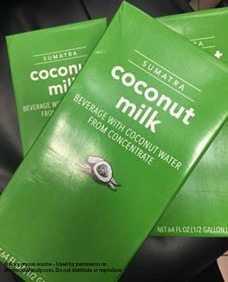 Starting February 17, 2015, you’ll be able to order coconut milk for your favorite Starbucks beverage.


