Monday, October 10, 2016

We're On the Eve of Disruption

E-commerce is here and it's not going away. How is your supply chain going to deal with the growing demands of omni-channel?
Dave Blanchard
Editorial Director/
Associate Publisher
"The transportation of information is more important than the transportation of goods."
Sounds like something a software solutions provider or maybe a tech consultant might say, doesn't it? However, those words in fact came from James Welch, CEO of national less-than-truckload carrier YRC Worldwide, whose career dates back to the pre-deregulation days of the late 1970s.
When somebody who's been in trucking since the Carter Administration says moving data is more important than moving stuff, you know that we've reached a business-as-unusual point in the industry—the era of disruption.
That certainly was one of the dominant themes at last month's Council of Supply Chain Management Professionals (CSCMP) annual conference in Orlando. Rather than just dwelling on how rapidly things are changing, though, the prevailing message is that it's fasten-your-seatbelts time because things won't be slowing down.
"E-commerce is the number one disruptive change to our business," says John Wiehoff, CEO of third-party logistics provider C.H. Robinson, a company that provides services to many of the biggest retailers and e-tailers in the world. "Virtually every mode we offer is being changed by the demands of e-commerce."
In this world of omni-channel distribution, consumers have been trained by Amazon and other large retailers to expect that they can receive any product from anywhere delivered for free or at least minimal cost, and that mentality has filtered through the entire transportation industry. Customers expect the carriers to figure out how to make money by delivering small shipments with greater frequency to out-of-the-way addresses. And customers really don't care if their freight is being delivered as a loss-leader opportunity—they just want their stuff.
"Consumers expect free shipping all the time now, but there's no such thing as free shipping," Welch points out. "We're certainly not going to do it for free, and nobody else is, either. Somebody is going to pay for it somewhere along the line," and that almost always means the end customer at some point will pick up the tab for the shipping, even if those expenses are buried in the cost of the product.
Not only do customers expect their stuff delivered rapidly and for free, but given the nature of e-commerce, they often order more products than they need knowing they can easily send them back for full credit. With companies offering more SKUs online but holding less inventory in their brick-and-mortar stores, moving goods through cross-dock operations at distribution centers has become a crucial logistics strategy.
"There's tremendous pressure on retailers to accept all returns from customers," Wiehoff says, but he sees that situation starting to take on more realistic dimensions. "As retailers gain more maturity in the e-commerce marketplace, I anticipate more positive disruption as they focus more on profitability than on service." So the days of ordering six shirts, hoping one of them will fit and then returning the other five, might not be such a prevalent practice once consumers start having to pay for the online convenience. Just look at how the once-consumer-friendly airlines are now tacking on charges for services that used to be offered for free, such as being able to pick your own seat or carrying a small suitcase onto a plane.
There's been a lot of talk about the so-called Uber-ization of trucking, but Wiehoff cautions against shippers who are imagining apps that will allow them to arrange for a driver to pick up a load at their door and drive it straight to their customer's loading dock.
"The commoditization of freight is a lot different than the Uber model of passenger pick-ups, due to all of the exceptions and requirements involved in freight carriage," he points out, especially given how closely and tightly regulated the motor carrier industry is. It's not likely the government will turn a blind eye to delivery companies that try to circumvent the labyrinth of rules involving Hours of Service, electronic logging devices, hazmat restrictions and emission controls, to name just a few.
"It seems like our industry is more regulated today than it was back in the pre-deregulation days," Welch observes. "We're being regulated to death."
Technology isn't necessarily a negative force but, when applied strategically, it can be a survival tactic when it comes to dealing with market and regulatory pressures. "If you're not investing in technology and constantly reinventing yourself, you're not going to be around very long," observes Jon Russell, president of truckload carrier Celadon Logistics. And that philosophy is as true for transportation providers as it is for shippers.


Sunday, October 9, 2016

Revisited: Whole Foods, Wal-Mart And The Coming Commoditization Of Organic Grocers

|
1 comment 
|
 About: Whole Foods Market, Inc. (WFM), Includes: WMT

Summary

Two years ago I wrote an article examining the organic grocery industry, and questioning the viability of the growth expectations priced into Whole Foods' stock.
Since then, Whole Foods has seen its growth slow significantly, largely driven by the massive increase in competition.
While Whole Foods is still a solid company, its stock is unlikely to see a return to the premium growth valuation multiples it once enjoyed.
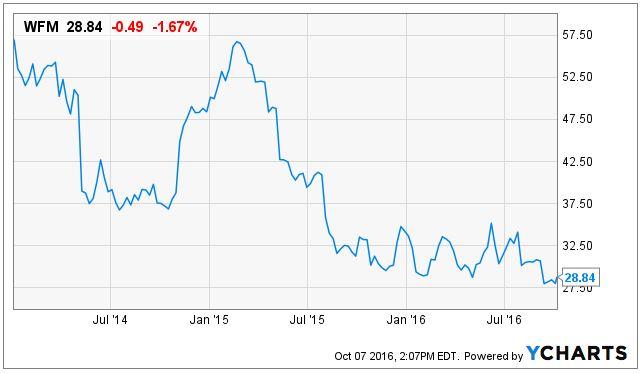
In July of 2014, I wrote an article here on Seeking Alpha titled, Whole Foods, Wal-Mart and The Coming Commoditization of Organic Grocers, in which I hypothesized that a coming shift in the organic grocery industry would spell trouble for Whole Foods Market's (NASDAQ:WFM) stock price. At the time, their stock had recently tumbled from the $60s down into the high $30s, leading many bulls to excitedly declare a buying opportunity. I presented a counter-argument to this case, cautioning that the premium valuation multiples that WFM had historically traded at had become outdated and that the stock had additional room to fall.
WFM Stock Price
Most, if not all, of my article was admittedly speculative and very much qualitative in nature. After all, I was making an educated guess at what the long-term future of a major industry would look like. Two years later, I believe that enough time has passed to check in and see how things are playing out.
While I encourage you to go read (or re-read) my initial article, my argument can be summarized as follows:
  1. The entry of Wal-Mart (NYSE:WMT) into the organic grocery industry in 2014, while not posing a direct threat to Whole Foods, signaled a significant shift in the broader industry. What was once a small niche market was quickly becoming a mainstream norm.
  2. Whole Foods would remain successful from a business standpoint.However, the growth expectations historically factored into their stock price would prove inaccurate. Industry-wide growth would be driven by demographics that are much more price-sensitive than the traditional Whole Foods shopper.
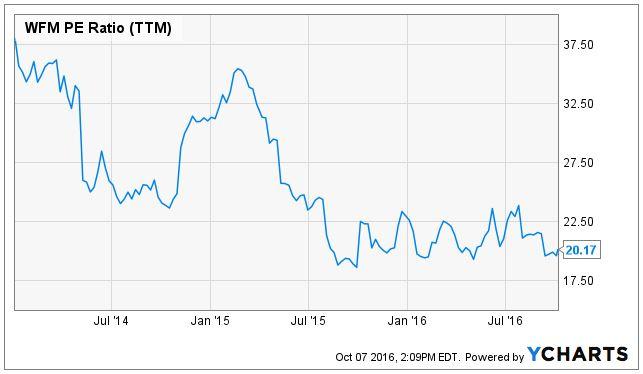
  3. While investors were accustomed to WFM trading in the 30-40x P/E range, buying below that range didn't necessarily make it a bargain.
WFM PE Ratio (NYSE:<a href='http://seekingalpha.com/symbol/TTM' title='Tata Motors Limited'>TTM</a>)
In short, I believe that my thesis is playing out as predicted and will continue to do so for the foreseeable future. Whole Foods' management seems to agree, taking time during recent conference calls to acknowledge the increased competition and introduce a set of new initiatives in response. While management is certainly taking action to address the situation, it remains to be seen if this will be enough to boost the stock price back to the premium valuation levels it once enjoyed.
The historical "bull case" for WFM has always seemed to rest on two major pillars: First, Whole Foods will eventually expand to management's stated goal of 1,200 stores (more than double their current store count). Second, Whole Foods will maintain their premium pricing power within the industry. I've long conceded that if both these points hold true over the long run, WFM is a must-buy at current prices. However, I have long questioned the long-term viability of these two pillars, and believe they are currently beginning to crumble.
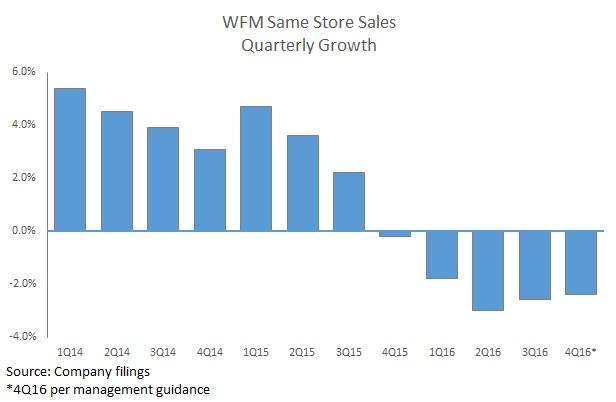
WFM Same Store Sales - Quarterly Growth
Looking at Whole Foods' business performance over the past two years, it's easy to see why the stock price has struggled. Same-store sales, once averaging 8% annually over a 15-year period, have fallen off a cliff. After steadily declining through 2014 and 2015, the metric went negative in Q4 of 2015 and is expected, per management guidance, to remain negative through at least the end of 2016. In their most recent quarterly earnings call, CEO John Mackey acknowledged that competition was taking its toll:
"[C]ompetition, I mean it's not a big secret, is it? There's a lot more competitors in the marketplace and there's a lot of new formats in the marketplace, from home meal replacement to meal kits, fast casual restaurant growth. More entrants in the natural and organic food space. The mainstreaming of natural organic, which has been well reported. These are all factors.
[…] We probably feel the brunt of it, as there's a bit of a regression to the mean as we lose customers from a convenience standpoint. People don't drive as far as they used to drive, because there's good enough alternatives in many cases close by to them.
So people may not be driving as frequently as far as they used to, because they can stop by a Kroger or an HEB or a Wegmans to get products that they can use to only be able to get Whole Foods… So, I think there's no sense in denying it."
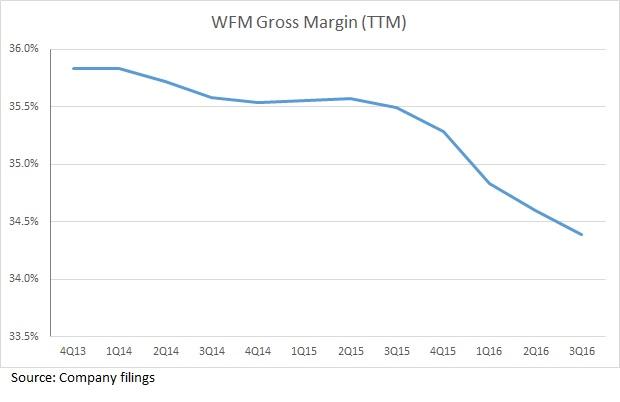
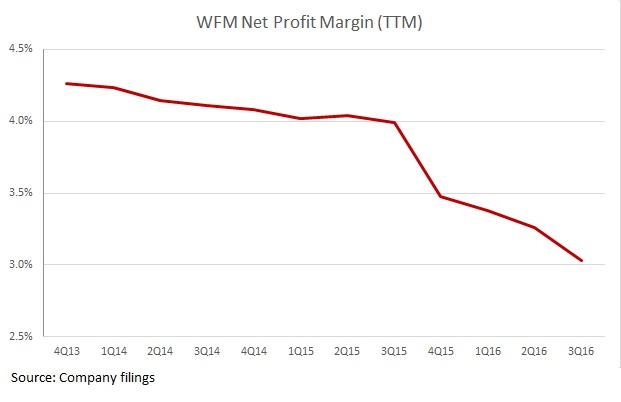
Along with the decline in same-store sales, Whole Foods has also seen their margins shrink significantly over the past two years. On a trailing twelve-month basis, gross margins have eroded from 35.8% to 34.4%, and net profit margins have dropped from 4.3% to 3.0%. To be fair, these margins are still quite impressive when compared with many other grocers, but they are indicative of management efforts to become more competitive on pricing.
WFM Gross Margins
WFM Net Profit Margins
Back in 2014, a major cause for concern among Whole Foods investors was the entry of Wal-Mart into the organic grocery industry. The overwhelming consensus, which I agreed with, was that Whole Foods and Wal-Mart were completely different companies catering to completely different demographics, and that it was absurd to think that Whole Foods customers would suddenly defect to Wal-Mart for lower prices.
However, in my initial article, I argued that while Wal-Mart's low prices did not pose a direct threat to Whole Foods, it did signal a massive shift in the broader organic grocery industry. While Whole Foods and Wal-Mart represent the two extreme ends of the industry, there are numerous other competitors at various points in-between. These include other mass retailers (Target (NYSE:TGT), Costco (NASDAQ:COST), etc.), traditional supermarkets (Kroger (NYSE:KR), Safeway (NYSE:SWY), Publix (OTC:PUSH), etc.) and "2nd tier" organic grocers (Trader Joe's, Sprouts (NASDAQ:SFM), Fresh Market (NASDAQ:TFM), Fairway (NASDAQ:FWM), etc.). I believe this is an important way to think of the organic grocery industry due to the demographics that are driving industry-wide growth. A recent report from the USDA states that:"organic products have shifted from being a lifestyle choice for a small share of consumers to being consumed at least occasionally by a majority of Americans." While the loyal Whole Foods "lifestyle" shopper may not be overly sensitive to price, the majority of Americans certainly are, and they are the ones who are driving the broader industry growth. While Whole Foods may not need to be concerned with how their prices compare to Wal-Mart, they do need to be concerned with how their prices compare to competitors like Trader Joe's or Sprouts.
In fact, on the WFM 2Q16 earnings call, company President & COO A.C. Gallo admitted that they were actively monitoring competitor pricing and cutting prices when necessary:
"We noticed last - I think starting in November that Trader Joe's had lowered prices in certain items, in certain markets. And we monitor Trader Joe's and other competitors very closely, and we make sure we have certain price bandwidth that we make sure that we follow with them. And so in key items that we saw Trader Joe's change pricing on, we changed pricing as well on certain items to make sure we maintained our proper bandwidth to them."
To give management credit, they've recognized that the competitive landscape has become a lot more challenging, and they are taking steps to make sure the company remains an industry leader. In the Q4 2015 conference call, CEO John Mackey acknowledged that the competitive landscape was shifting, and laid out a 9-step plan for adapting. These steps include reducing operational costs, an increased focus on private-label brands, increasing sales and promotional activity, and launching a new brand of small-footprint "365" stores.
These new initiatives will likely have a positive impact, and Whole Foods will likely continue to operate as a successful company. However, it is unlikely that these initiatives will return the company to their high-flying growth numbers of the past. Investors expecting an imminent return to the $50s or $60s may be better off dumping their shares in the compost pile instead.

Friday, October 7, 2016

Meet the Cyber Sam Walton

New Walmart e-commerce CEO Marc Lore and Walmart CEO Doug McMillon at the investor meeting.
Wal-Mart Stores Inc.
The new head of Wal-Mart Stores' e-commerce business was introduced this week as a kind of Cyber Sam Walton, whose innovative approach to the online shopping trip will pioneer what CEO Doug McMillon termed "EDLP 2.0."
Marc Lore, who was named CEO of e-commerce at Walmart when the retailer acquired his Jet.com business for $3.3 billion less than a month ago, was short on the specifics of how he would transform Walmart's considerable but relatively lagging e-commerce business, but reiterated that the big retailer and its entrepreneurial new e-commerce leader shared a vision for success in retailing by attacking its inherent costs and passing them along to consumers. He also expressed confidence that the combination of Walmart's existing assets and Jet's virtual expertise could accelerate the vision of "seamless" shopping long pursued by his new employer.
"I couldn't be more excited when I look around and see the vast assets that are at our disposal here," Lore said during remarks at Walmart's investor meeting Thursday in Bentonville, Ark. "The foundation has been laid in terms of the warehouse network. I think the decision to build five mega centers was the right one. There's incredible automation there and they're just starting to come up online, and so it's sort of like the perfect time to really accelerate the business. The sourcing capabilities relative to what we experience is not even close."
Lore said Jet.com was founded behind the notion that e-commerce marketplaces, such as Amazon, were "incredibly inefficient," because they are built so as to award sales to the lowest price item provider, regardless of the costs associated with fulfilling the order. Jet.com's breakthrough, he said, was to craft a technology that not only takes fulfillment costs into the equation, but builds baskets by making the process transparent to shoppers, showing them what the savings are of buying one product over another, and by also employing other incentives to save such as options on payment methods, shipping times or returns.
"So for example, if you have two things in your shopping cart, let's say, a bag of dog food and a dog bowl, and now you search for a dog leash, we'll, in less than a second, calculate the marginal cost to ship each one of those leashes in relation to what's in your shopping cart, knowing where you live in relation to all known inventory pools," he explained. "So some leashes, obviously, we'll bill to ship together. And in that case, the marginal cost to ship will be almost nothing, or it may ship completely separately and it might be $5. The idea is to try and encourage consumers to buy things that will ship together from a location in close proximity to where they live."
These basket economic ideals, which McMillon termed "EDLP 2.0" could transform not only Walmart's existing e-commerce business, but its stores and culture, McMillon told analysts. "EDLP still has a place in life that lowers cost and is very powerful," he said, "And on top of that, if you can let customers play a role in this process — a legitimate, authentic, transparent opportunity for customers to participate in a way that helps lower systems cost and you give that money back to them — you can win. We did that before and we want to go do it again."
Specific details on how it will all play out may have to wait.
Lore for example said fresh food would be "a critical part of the strategy going forward," but, like Walmart, it was still experimenting on the best way to conquer the last mile there. Walmart has focused on store grocery pickup, but is also testing its own delivery fleet as well as using Uber and Lyft for delivery in some markets. Jet ships food from a centralized distribution center. "One thing is for sure, we're going to be really focused on winning in fresh and consumables over the next couple of years," Lore said. "And we're just not quite sure what the final best way to do it is, but we're experimenting."
Read More: http://supermarketnews.com/walmart/meet-cyber-sam-walton#ixzz4MRpyVR4h

Wednesday, October 5, 2016

Digital Trendsetters: Secrets of the Most Successful Supply Chains

What is in this article?:

  • Digital Trendsetters: Secrets of the Most Successful Supply Chains
  • Never Walk Alone
Having a super-flexible supply chain is as critical as having a super-efficient one.
Digital disruption is changing markets everywhere, and a highly efficient supply chain is only half of the story. Today's digital customers, in both B2C and B2B environments, want experiences as unique as they are, delivered "on demand"—and at hyperspeed. That makes a super-flexible supply chain as critical as a super-efficient one and digital capabilities have a critical role to play.
Although 85% of organizations have introduced the digital technologies that help enable supply chain flexibility, or plan to do so within a year, most still haven't realized the full, value-driving potential of these technologies.
One group, however, is different. We call them "digital trendsetters," and they are the top performers in terms of both profitability and revenue growth in our survey of 400 senior supply chain executives across 14 countries. These trendsetters are breaking away from the pack of "digital followers" because they are responding to digital disruption differently. Here's how.

Think Enterprise, Not Just Supply Chain

Digital trendsetters look at things differently. They use digital to own the customer experience, end-to-end, across the ecosystem. Unlike digital followers, whose approach is transactional and focused on providing an improved shopping and buying process, and faster and more flexible fulfilment, trendsetters take a more strategic view. They look to strengthen their ongoing customer relationships with regular updates about products and services, online self-service, support and feedback. In short, they use digital to enhance existing business models and develop new ones. By taking this strategic approach, trendsetters also drive value for the enterprise as a whole versus only for the supply chain organization.
Although 63% of trendsetters expect digital technologies to drive revenues, they haven't abandoned traditional processes and operational efficiencies—to the contrary. Cost reduction and on-time delivery remain important key performance indicators (KPIs) for them. But trendsetters have transcended these measures. They systematically use such additional KPIs as cost-to-serve, customer satisfaction and market share—and significantly outperform digital followers on these measures.

Raise Your Technology Game

By embracing controlled volatility, digital trendsetters aim to treat customers, products and suppliers differently—on purpose and on their own terms. They design their supply chain operations around the intersection of suppliers, products and customers, all the way to the end consumer.
However, unlike digital followers, who say that giving their customers a unified experience remains their primary supply chain objective, trendsetters strive to deliver a hyper-tailored customer experience: highly individualized, focused products and completely customized services providing buy-anywhere, collect-anywhere, return-anywhere capabilities via flexible channels.
For example, global energy management company Schneider Electric has leveraged digital to identify 10 different customer segments based on need, and it operates four different supply chain models for a hyper-tailored customer experience.
Hyper-tailored products and services require hyper-flexible capabilities, and trendsetters know that leveraging the full spectrum of digital technologies is key to enabling them. They continue to invest in analytics, mobility and the cloud—the digital technologies most highly favored by digital followers. But trendsetters also take digital further, investing significantly more than followers in the higher-order digital technologies that facilitate hyper-flexibility.
In fact, almost three times as many trendsetters as followers invest in artificial intelligence. Nearly twice as many trendsetters invest in the Industrial Internet of Things (IIoT) and intelligent products. Bottom line: Trendsetters outspend followers on digital 8:1 overall.
Cases in point: General Electric's Brilliant Manufacturing initiative leverages IIoT technology and advanced real-time analytics. The system enables decision-makers with the real-time visibility and deep operational intelligence needed to respond more quickly to unexpected events, as well as to balance plant production with quality and profitability objectives.
Amazon.com's patent for an "anticipatory shipping" system draws on a deep knowledge of customer preferences to ship orders before the customer has clicked "buy." The system also minimizes returns costs by giving discounts or allowing customers to convert unwanted deliveries into gifts.
As ownership of technology decision-making shifts from the CIO to the C-suite, executives responsible for individual business areas, COOs and CSCOs will also need to raise their technology game.

Never Walk Alone

Digital trendsetters are leveraging their digital investments to build new levels of collaboration—well beyond their four walls. Creating a flexible ecosystem where everyone has access to the right information to work together collaboratively toward a common goal is a top priority for as many as two-thirds of them. Unlike followers, whose focus remains on enabling collaboration among internal functions, trendsetters' ecosystems encompass all stakeholders, including start-ups, in a broad, fluid and proactively managed network.
One global aircraft maker, for instance, uses a cloud-based platform to track and manage supplier risks across a number of KPIs. The platform has enabled the company to secure the operational performance of a multi-tier network of suppliers challenged to keep pace as new aircraft production ramps up.
Trendsetters recognize the risks of data sharing, but they have used digital to enable safe, swift and easy access to information. By engaging proactively across a broad and fluid ecosystem, trendsetters are driving significant innovation.
An automotive company, meanwhile, incubates internal start-up groups that provide a means of rapidly developing and testing novel business opportunities in the mobility segment. Ideas can come from in-house "intrapreneurs" or outside sources, including a network of start-ups.

A Way Forward

Only the digital trendsetters have successfully combined all enabling digital technologies to drive superior performance. Coupled with their strategic focus and the courage to collaborate openly with outsiders, their digital capabilities help them gain a first-mover advantage in today's on-demand markets.
Trendsetters follow a predictable pattern: They pinpoint what capabilities they need next, take action to implement them in a meaningful way, and capture the benefits.
By taking the following steps, businesses can respond differently to digital disruption and transform their supply chain into a driver of significant new value:
Reinvent your supply chain business case. Preserve basic efficiencies—but examine how you could change your value proposition with digital and enable growth at speed for the enterprise as a whole. You can't, and shouldn't, do it all. Go after what can make a disproportionate impact on growth and profitability. New areas of focus, additional KPIs that capture market share and revenue generation, new tracking tools, and even more cross-functional governance will be needed.
Rethink your operating model. Scan your supply chain for digital enablement and let digital inform how you can reimagine your supply chain to truly reap its benefits. Up your spending on the more sophisticated technologies but don't fall prey to "bolting on" new technology to an old model—only a fraction of your potential will be realized. Look at the high financial impact technologies and ask, "What bold new moves should we make in our strategy, processes and organization to push far beyond today's reality?" And remember: If supply chain organizations cannot proactively propose capabilities to enable new models, the rest of the business will source them elsewhere.
Reimagine your ecosystem. Expand your ecosystem beyond your four walls and leverage digital to access and share data, while managing cyber-security risk. Engage proactively with strategic partners, including third-party partners and digital start-ups, to help you jumpstart innovative, value-enhancing capabilities.
Trendsetters know that what constituted a great supply chain yesterday is no longer good enough today. By doing digital differently, they are transforming their supply chains into superfast, digitally disruptive, hyper-flexible and highly collaborative enablers of superior customer service and profitable enterprise growth. 

No Bluffing: Amazon Is Shopping For A Logistics Partner

I write about the supply chain industry.  
An Amazon logo sits on a cardboard delivery box as an employee processes customer orders ahead of shipping at one of Amazon.com Inc.’s fulfillment centers. (Chris Ratcliffe/Bloomberg)
In business as in poker, it can pay to be unpredictable. And make no mistake, bluffing works well in situations where the stakes are high and the bluffer has a better stack than opponents. That said, bluffing only works when your opponents don’t suspect you’re doing it, so the more analysts speculate about whether Amazon has the chips to bluff or bully companies the size of UPS and FedEx FDX +0.38% into making costly errors, the less it’s likely to happen.
Amazon has been building out its logistics capacities at a scale indicative of a hedge strategy (it can sell its excess capacity by the piece or by the pound to whoever and whenever). Yet despite how fully hedged its bets may be, it remains vulnerable. Why? Because its hand is so powerful that played irresponsibly, it could force its opponents to collude and refuse to play. That’s the downside Amazon must guard against –and it’s real.
What if Amazon actually wants to rid itself of the pretense and make a win/win logistics deal with a trusted partner?
Last year, Amazon spent $11.5 billion on shipping, or 10.8% of sales. If Amazon were to handle fulfillment all by itself, according to the Wall Street Journal, Citigroup C +1.88% estimates a potential savings of $1.1 billion annually. Regardless of whether it’s UPS or FedEx, building-out last mile capabilities to a futuristic spec –on Amazon’s dime—is a prize not a curse.  Logistics is hard and last mile delivery is easily the most challenging, costly and least profitable part of the puzzle. If Amazon can find a like-minded partner to share that risk, someone who sees the long-term value of the investment, it would seem like a better path forward. So the question is, how much of that annual logistics savings is Amazon willing to share, for how long and with whom?
Oh, I suppose Amazon will do its share of posturing. But it would be a mistake for it to overplay its hand at this stage. It needs a high integrity deal with an established logistics partner who can share some risk and smooth out some of its seasonal demand curves. It needs a partner who understands, like Amazon, that the game they structure and the strength of their respective commitments to its rules, will ultimately determine the level of success. After all, this isn’t a zero sum game.

The World Economic Forum's annual competitiveness report shows where US education lags behind other countries

The World Economic Forum (WEF) released its 2016-2017 Global Competitiveness Report, and while the United States ranked 3rd among the 138 economies surveyed overall, on education, its competitiveness lagged behind.
On the indicator of higher education, the US ranked 8th, while it ranked 39th for health and primary education competitiveness.
The report further breaks apart the components of the health and primary education indicator, ranking the US 46th for primary education and notes that the Organisation for Economic Co‑operation and Development (OECD) country average beat the US in health and primary education.
Donald Trump often touts the fact that the US trails other countries in rankings of primary education.
"You have Norway, Sweden, Denmark, China, you have lots of places. You have some countries you’ve never even heard of are ahead of the USA," he said at a rally in February, before vowing to improve American education.
Below is the top 5 ranked countries, in terms of primary education, in the WEF report: 
  1. Finland
  2. Belgium
  3. Singapore
  4. Netherlands
  5. New Zealand
In higher education, however, the US performed better, ranking 8th. A low number within the top 10  is still a bit surprising as US colleges and universities are known for their strength. For example, on the Center for World University Rankings the top top 1,000 universities in the world, 224 are in the US, 90 are in China, 74 are in Japan, and 65 are in the United Kingdom.
Below  is the top 5 ranked countries, in terms of higher education, in the WEF report: 
  1. Singapore
  2. Finland
  3. Netherlands
  4. Switzerland
  5. Belgium
The ranking included measures of secondary (high school) and tertiary (college and beyond) enrollment rates, quality of education system, and quality of math and science education.
Along with quantitative statistics, the report utilized qualitative measures from an executive opinion survey where comparable statistical data was not available.