After little more than a year of using olive oil from Greece for its Kirkland Siganture extra virgin olive oil, warehouse giant Costco has apparently switched back to Italy as the source for its green-gold elixir.
Costco switched to using extra-virgin olive oil (EVOO) from Greece for its private-label 2-liter bottles last year after the disastrous 2014-2015 harvest — plagued by bad weather, pests and wasting diseases — that saw Italy’s production plummet and prices soar.
But after a better 2015-2016 worldwide harvest, and with Italian EVOO production bouncing back and prices going down, Costco reportedy made the switch back to Italian, according to Olive Oil Times.
“It was what members wanted. They’re used to what they’re used to and there’s a perception that Italian EVOO is top-of-the-line. The Greek oil did OK — I myself preferred it in a blind tasting — but it was not quite as strong a seller,” Olive Oil Times quotes Chad Sokol, commodity and dry grocery buyer for Costco’s Northern California and Nevada stores, as saying. “And pulling our buy out of Italy was significant. Their pricing came down as a reaction, and that was our hope as well.”
It’s debatable whether the Italian olive oil price drop was in reaction to Costco’s earlier pullout or due to a better harvest. Costcodid not respond to a request for comment on the switch back to Italian EVOO for its private label bottle.
The 2015-2016 worldwide harvest is far better than the dismal 2014-2015 one, and production in Italy is up 112 percent, according to Olive Oil Times.Producer prices for Italian EVOO were down 35 percent from the same period a year ago, according to a June newsletter from the International Olive Council.
But David Neuman, CEO of the North American unit of Greek olive oil company Gaea, still sees opportunity for Greek EVOO.Neuman’s company, whose oil is still carried by Costco, has predicted the supply of Italy’s EVOO will drop drastically in the upcoming 2016-2017 harvest. Factoring in everything from the flowering of the trees to the weather, it forecasts that Italy’s production will be down 40 percent, while Greece’s will be down 35 percent.Since Greece, the world’s third largest producer of olive oil after Spain and Italy, uses less EVOO domestically than Italy does, it will have more to sell, Neuman believes.
Plus, Italy has been plagued by reports of less expensive oils labled as EVOO. (Costco, in its recent newsletter, says it has “worked diligently to ensure its Kirkland Signature EVOO is authentic and traceable.)If the upcoming harvest is as bad as it was two seasons ago, asked Neuman, “will Costco go back to Greece or somewhere else?”
Fewer cigarettes, more fruits, veggies at tobacco stores
Patt Johnson, pjohnson@dmreg.com11:04 a.m. CDT August 26, 2016
Kwik Trip grocery driver Dave Strangeland of Waterloo delivers eggs and other produce to the Tobacco Outlet Plus on Wednesday, Aug. 24, 2016, in Des Moines. The store on Des Moines south side is one of the first to have fresh produce on its shelves along with the traditional convenience store products. Brian Powers/The Register
A Wisconsin-based convenience store chain is de-emphasizing cigarette sales and instead focusing on fresh and prepared foods at its tobacco shops in the Des Moines metro and across Iowa.
Kwik Trip Inc. has started transforming its Tobacco Outlet Plus stores into Kwik Star Express markets that will feature fresh fruits and vegetables, baked goods, fresh meat, sandwiches and entrees. The transition will take a couple of years, as the company looks for new locations for its express markets, with room to add fuel pumps.
The Tobacco Outlet at 3019 SE 14th St. in Des Moines has added some of the new products — bread, milk, bananas, potatoes, eggs and onions — grocery basics, said Robert Nichols, store manager. The store still sells tobacco and offers cigars in the walk-in humidor, but the cigarettes are behind the counter, making the store accessible to under-18 customers, he said.
Kwik Trip is joining the convenience store industry trend of relying less on cigarette sales, once a top seller. Locally based chains such as Casey’s General Stores Inc. and Kum & Go are building bigger stores and carving out more space for pizza, sandwiches, doughnuts, breakfast sandwiches, salads, fresh fruit and more.
Kwik Trip — which goes by Kwik Star in Iowa so it isn't confused with convenience store chain QuikTrip — is finding success with groceries.
“Tobacco products are not part of the future,” said Hans Zietlow, director of real estate for the family owned business based in La Crosse. “Beer, tobacco, potato chips, that’s the old concept of convenience stores. We’ve become more of a fresh market.”
Following 11 years of declines, overall cigarette sales in the United States were static in 2015, according to Euromonitor International, a global market research firm. At convenience stores, cigarette and tobacco sales account for about 36 percent of sales, excluding fuel, industry associations report.
Kwik Trip operates 18 Tobacco Outlet Plus stores in Iowa, including five in the metro that will be converted to Kwik Star Express markets in the next four years, he said. Most will be moved from strip malls to stand-alone buildings that will each include a handful of gas pumps.
Zietlow said the company also is planning to build full-sized convenience stores in the metro and is close to sealing a deal on an existing convenience store near U.S. Interstate 35/80 that it will convert to a Kwik Star.
The larger, newer Kwik Trip/Star stores top 7,000-square feet, at least 2,000-square feet larger than the most spacious Kum & Go or Casey’s. The grocery and prepared food sections have more expanded offerings than the express markets.
The company is looking to bring about six full-size convenience stores to the Des Moines area, in addition to the converted tobacco stores.
Kwik Trip's aggressive growth plan is to open 50 stores in the next five years, adding to its stable of 532 stores, Zietlow said. That will be a combination of convenience stores and market express stores.
Kwik Trip is looking to tap into a customer base that is seeking food staples, prepared foods and quick in-and-out service to accommodate their busy lives. Bananas, potatoes and onions each cost 38 cents a pound, all 20 cents a pound or more below grocery store prices.
The company can keep prices low because it bottles, bakes and ships products daily from its 120,000-acre campus in west-central Wisconsin, Zietlow said.
Kwik Trip processes its own milk and other dairy products like yogurt, ice cream and orange juice in 150,000-square-foot dairy under the brand name Nature’s Touch. Bread, doughnuts, cookies, muffins and bagels are made in 212,000 bakery under the Kwikery Bake Shop brand.
And all of the Kwik Trip/Star Kitchen Cravings sandwiches, salads, wraps, pizza and other prepared foods are made fresh daily in the company’s 65,000-square-foot commissary. The warehouse covers about 360,000 square feet, which includes a temperature-controlled room that ripens bananas and other fruits before being sent to stores.
“We sell tons of bananas. They come in green, and we put them in the ripening room so they can go out to the stores just at the right ripeness,” he said.
Zietlow, 56, said plans are in the works to build a $120 million bakery to expand offerings and accommodate new stores. Kwik Trip uses a fleet of about 300 semis to make daily deliveries to all of its stores in Wisconsin, Iowa and Minnesota, he said.
Having its own production facilities also allows Kwik Trip to sell groceries and prepared foods at cheaper prices, eliminating the middle man, Zietlow said. "Milk for example, we say goes from cow to store in 24 hours."
Casey's General Store executives came to see the Kwik Trip operation, which has been in place for decades, Zietlow said. The vertical integration system is a key to the company's success, he said.
“Kwik Trip is extremely competitive,” said David Livingston, a Waukesha, Wis.-based grocery store analyst. “They sell bananas for 38 cents a pound, potatoes for 38 cents a pound, onions for 38 cents a pound. They also are getting into high quality meats, not a lot of them, but a good selection.”
The company also offers promotions for gas discounts and other coupons to lure customers to the store, Livingston said. “They are knocking the crap out of the competition,” he said.
Company president Don Zietlow, who is Hans Zietlow’s uncle, said employee benefits include 40 percent pretax profit-sharing, and employees who work 20 years with Kwik Trip get four weeks off with pay, on top of their normal vacation, Don Zietlow said.
“Either part-time or full-time, clerk or store leader, they deserve the time off,” he said.
Monday, August 29, 2016
Why Electric Cars Will Be Here Sooner Than You Think
Adoption of electric vehicles will not be gradual, because the factors required to unlock demand for them are in place
ENLARGE
Hy-Vee, a Midwestern grocery chain, installs charging stations at all its new locations. The number of commercial charging stations is growing quickly.PHOTO:ACKERMAN + GRUBER FOR THE WALL STREET JOURNAL
In 2015, about one in every 150 cars sold in the U.S. had a plug and a battery. But mass adoption of electric vehicles is coming, and much sooner than most people realize.
In part, this is because electric cars are gadgets, and technological change in gadgets is rapid.
One big leap is in batteries. A typical electric vehicle today costs $30,000 and will go about 100 miles on a charge, if that. Within a year, you’ll be able to get double that range for just a little more money.
Tesla Motors Inc. is the standard-bearer, promising a Model 3 vehicle meant to appeal to the masses at $35,000 without incentives and more than 200 miles of range. By comparison, the average new car in the U.S. today sells for about $33,000.
But Tesla is hardly alone. Later this year, Chevrolet will roll out its $37,500 Bolt EV. It, too, boasts more than 200 miles of range, which appears to be the new goal for eliminating “range anxiety”—the fear that a vehicle will run out of juice—among potential electric-vehicle buyers.
And that is just the start. Pasquale Romano, chief executive of ChargePoint Inc., the world’s largest maker of electric-car charging stations, says he works with, and talks to, most major car companies. “We have seen their internal plans to just electrify everything,” he said.
In the short run, many of these cars will be plug-in hybrids, with both electric motors and gasoline engines. It makes sense to lump them with electric vehicles because most new models have enough battery power to get the average U.S. commuter to work and back without using any gasoline.
Steve Majoros, a marketing director at General Motors Co.’s Chevrolet unit, says that 90% of trips and 65% of miles driven in its Volt plug-in hybrid are on electric-only mode. The Volt can go 53 miles on a charge.
Every plug-in hybrid is effectively an electric car that is carrying a “range extender,” just in case. They will help electrify a large share of the miles Americans drive. They’ll also help ease consumers into electric vehicles, overcoming any remaining fear about being stranded after running out of juice.
Competition among electric vehicles and plug-in hybrids will be intense, which will drive down prices. Volkswagen AG has pledged to make every model available as a plug-in hybrid by 2025. BMW AG has made the same promise. Hyundai Motor Co. promises eight plug-in hybrid models by 2020, plus two all-electric vehicles. Toyota MotorCorp.’s overhaul of the plug-in Prius, boasting twice the range, arrives before the year is out.
ENLARGE
The Chevrolet Bolt EV in January at the North American International Auto Show in Detroit. Hybrid and electric vehicles are rapidly gaining popularity.PHOTO: PAUL SANCYA/ASSOCIATED PRESS
Another trend will help—the proliferation of charging stations. ChargePoint Sunday said it has 30,000 stations in its network, where it collects any fees levied by owners. By comparison, there are about 90,000 publicly accessible gas stations in America, says Mike Fox,executive director of Gasoline & Automotive Services Dealers of America.
The number of commercial charging stations is growing quickly in part because they’re relatively cheap—costing $3,000 to $7,500 per port, depending on whether it is new construction or a retrofit. When attached to a business, they can attract customers, and encourage them to stay longer and spend more.
Hy-Vee Inc., a chain of 241 grocery stores in eight Midwestern states, installs charging stations at all its new locations; it has four chargers at each of 42 stores. Charge times for electric cars vary widely, depending on the station and car make, but it typically takes 30 minutes to an hour to get a decent charge. Conveniently, that is roughly as long as it takes to have a meal, says John Brehm, director of site planning at Hy-Vee.
Placing charging stations at workplaces, where cars spend much of their time, will be uniquely powerful. When a workplace installs a charging station, employees are 20 times as likely to buy a vehicle with a plug, according to a survey from the U.S. Department of Energy.
Drivers won’t switch to electric vehicles as rapidly as consumers adopted smartphones. The average American keeps a car for 11 years. For most people, though, by the time you’re ready to buy another car, there will be a range of plug-in vehicles available at prices comparable to gasoline vehicles. And that doesn’t count the projected savings in fuel, or in maintenance, since electric vehicles have many fewer moving parts.
It is the nature of disruptive technological shifts that it seems like nothing is changing—until it seems as if everything is changing at once. Electric vehicles have been a long time coming, but they now represent such a clear and present threat to the gasoline engine that Mr. Fox, of the service-station association, now recommends that members signing long-term contracts for fuel include an option to renegotiate if more than 10% of a state’s fleet goes electric.
If Tesla can deliver on its current promises with the Model 3, says Mr. Fox, “gas vehicles are history—it’s horse and buggy days.”
Supply Chain News: Inventory Management by Retail Category
We Aggregate Inventory Turns Across More than a Dozen Retail Sectors
Aug, 29, 2016
Supply Chain Digest Editorial Staff
Every year, REL, a Hackett Group company, assembles data on working capital management. One of the three components of working capital is inventory, which REL measures in terms of Days Inventory Outstanding, or DIO. DIO is calculated as follows: End of Year Inventory Level/[Total Cost of Goods Sold/365]
Supply Chain Digest Says...
Retailers also have a higher ITS than do manufacturers or wholesalers. The June ITS, for example, was 1.50 for retailers, versus 1.35 for manufactures and 1.33 for wholesalers.
So, you calculate the average cost of goods sold forone day, and then see how many of those COGS days you keep in inventory (based on year-end balance sheet numbers).
As such, DIO is sort of the reverse of inventory turns, in that a higher DIO, all things being equal, means poorer inventory management performance, while a lower number signals improvement. You are being more efficient with inventory versus a given level of COGS. Fortunately, with a number for DIO, inventory turns can also be calculated.
That formula is as follows:
Turns = 1/(DIO/365)
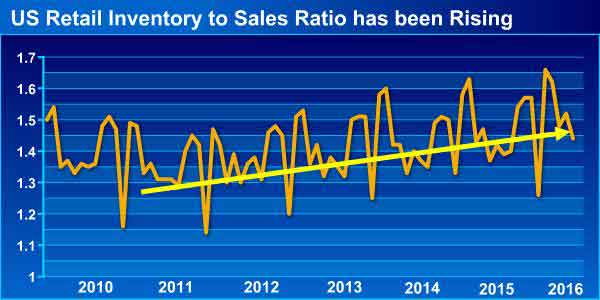
As we reported in the July issue of the Retail Vendor Performance Management Bulletin, retail inventories in general have been rising, certainly as measured by the Inventory-to-Sales (ITS) ratio, published by the US Commerce Dept.
The ITS ratio measures the amount of inventory held as a percentage of one month's worth of sales. As can be seen in the chart below, while the retail ITS is highly seasonal, the trend since 2010 is definitely up.
Visit the Retail Vendor Performance Management home page to learn more
and subscribe to the monthly newsletter.
Retailers also have a higher ITS than do manufacturers or wholesalers. The June ITS, for example, was 1.50 for retailers, versus 1.35 for manufactures and 1.33 for wholesalers.
SCDigest's biggest value-add is taking the data REL makes available to us, based on fiscal year 2015 results, to first re-categorize the companies into more narrow sectors, enabling better comparisons.
This is especially true for retail, for which we break small number of sectors in the REL data into a number of more narrowly defined categories.
We also add in a number of retailers not in the REL data to make some of the retail sector populations more complete. For both REL or SCDigest's work, retailers must be public companies to be able to grab data for COGS and inventory levels from financial filings.
With all that said, here are some inventory turn numbers for leading retail sectors (the numbers in parentheses denote how many retailers are in each category):
• Grocery (8): 13.0
• Home Improvement (3): 4.3
• On-Line (4): 11.1
• Mass Merchants + Dept. Stores (11): 4.2
• Drug Stores (3): 8.7
• Dept. Stores (8): 3.4
• Mass Merchants (3): 8.1
• Footwear (4): 3.4
• Office Products (2): 6.8
• Sporting Goods (3): 2.7
• Electronics (3): 5.6
• Auto Parts (4): 1.5
• Specialty Apparel (15): 4.4
By way of comparison on the manufacturing side, consumer packaged goods companies had 5.5 turns on average in 2015, and apparel manufacturers had turns of just 3.0.