Tuesday, March 28, 2017

One reason why retailers are struggling: Americans are tapped out


If you are wondering why US retailers are feeling a strain, look no further than the latest report from the Federal Reserve Bank of New York that stated 33 percent of Americans said they could not come up with $2,000 over the next 30 days if the need arose.
Many Americans do not have the means for emergencies or for a family member’s needs — like a quarter of a ObamaCare deductible, or even enough for 25 percent down payment on the average cost of a funeral — according to the New York Fed’s Consumer Credit Access Survey.
No matter how you look at it, average Americans are tapped out.
There is one glimmer of hope in terms of the financial fragility: The study shows that since the election, there has been a modest uptick in the percentage of households that feel they could come up with the cash.
In October, 65.9 percent of households said they could get the cash. Today, it’s 67.2 percent. The report’s data also point to more Americans giving up on applying for credit — not even for credit cards or a mortgage, or even a personal line of credit often used for starting small businesses.
The percentage of people in the study who indicated that they would likely apply for a minimum of one type of credit over the next 12 months fell from 27.8 percent in October to 26 percent, the lowest level on record in the study.
Think about that: 75 percent of Americans don’t think they will even bother applying. And the fall is even worse for those with credit scores under 680.
Let’s face it, it’s always hard to chase dreams like starting a business or buying a home. In today’s economy, it’s so damn near impossible that people have given up.
President Trump’s optimism has helped turn the tide of business leaders and the financial markets, but the kitchen table economics will not change for many Americans until credit becomes less hamstrung by regulation.

Wal-Mart is 'best positioned' in online grocery battle against Amazon

Ashley Green, 31, talks to a Walmart personal shopper as she retrieves her online grocery pickup order at the chain's Franklin, Tenn., location.
Sarah Halzack | The Washington Post | Getty Images
Ashley Green, 31, talks to a Walmart personal shopper as she retrieves her online grocery pickup order at the chain's Franklin, Tenn., location.
Wal-Mart Stores appears "best positioned" among the major food retailers to capitalize on the next phase of growth in online grocery and take on Amazon, according to a new report from Citi Research.
Kroger also scored high among the pure-play grocers in terms of its online grocery positioning compared with e-commerce giant Amazon, particularly as it related to pricing. But at the bottom of the list was Whole Foods Market.
Citi looked at the potential winners and losers in the online grocery space using a five-point analysis that looked at factors such as profitability, brick-and-mortar pricing, online pricing, exposure to Seattle-based Amazon, as well as any early adopter advantage.
"Based on our analysis, we determined that Wal-Mart was the winner (low exposure to Amazon Fresh/Prime Now markets and low EPS impact from exposure to those exposed markets)," Citi said in the 43-page report. "Whole Foods Market came in last place overall in our
analysis, largely due to their urban store exposure, which overlaps highly with Amazon Fresh and Prime Now, as well as their higher price points."
Online grocery shopping could grow five-fold over the next decade, with American consumers spending upwards of $100 billion on food-at-home items by 2025, according an forecast released earlier this year by Food Marketing Institute and Nielsen.
While many of the large grocers are still testing and investing in different formats to see which one works best, there's no denying the changing demographics and rise of millennials weaned on digital technologies supports the case for significant future growth in online grocery spending.
Amazon's growing presence in the grocery space with different approaches highlights how much profit potential it sees in capturing spending from food and beverage sales. Amazon's grocery operating margin potential could be about 3 percent, or roughly comparable to North American retail industry margins, according to Citi. The estimate assumes inclusion of revenue from membership fees.
Amazon's prices on grocery items tend to be higher than Wal-Mart, which accounts for about 20 percent of grocery sales domestically. Citi's research found the price gap between Wal-Mart's store pick-up prices relative to AmazonFresh was an average of 30 percent.
Wal-Mart has been rapidly expanding its online grocery business and concentrating on the so-called click-and-collect model, which allows consumers to pickup orders at stores. A spokesman for the retailer told CNBC the retailer has expanded pickup to more than 100 markets in the U.S. last year and now has more than 600 locations offering the service.
InstaCart employees fulfill orders for delivery at the new Whole Foods Market Inc. store in downtown Los Angeles, California.
Patrick T. Fallon | Bloomberg | Getty Images
InstaCart employees fulfill orders for delivery at the new Whole Foods Market Inc. store in downtown Los Angeles, California.
Whole Foods has partnered with Shipt for third-party grocery delivery and uses InstaCart too. Rival organic and natural foods chain Sprouts Farmers Market has an alliance with Amazon Prime Now.
According to Citi, Whole Foods has more than 60 percent of their stores overlapped with Amazon's current or future delivery markets while Wal-Mart is just 23 percent exposed. Sprouts also has a high overlap with Amazon delivery markets but given the partnership Citi said that "could therefore be a complementary, rather than adversarial scenario and could mute the threat, or even create an opportunity."
Yet Wal-Mart's exposure and threats from Amazon go well beyond groceries and include other merchandise categories, Citi noted. Similarly, Costco and Target also have online grocery activities through mostly third party services and compete with Amazon on several fronts such as consumer electronics, among other things.
As for Kroger, the Citi report found that in addition to its competitive pricing compared with Amazon that the Cincinnati-based grocer was poised to benefit from growth in online grocery due to its "early adopter advantage."
Even so, Kroger maybe seeing market share erosion in some markets against Wal-Mart, according to analysts. They believe part of the reason is the price-cutting strategy Wal-Mart embarked on to gain advantage against Kroger and Aldi, a rapidly expanding deep discounter.
"Kroger looks like they're losing share," said PiperJaffray analyst Sean Naughton. He explained that Kroger's same-store sales trends have been lagging Wal-Mart's in groceries.
Meantime, analysts suggest both Wal-Mart and Kroger are likely to continue expanding their "hybrid" online grocer model, which includes focusing on both click-and-collect or in-store pickup as well as utilizing third-party or direct delivery services.
"Both models are going to thrive in 2017 and 2018," said Diana Sheehan, director of retail insights for Kantar Retail. "I would actually predict that within 3 to 5 years — maybe sooner — that we would start to see some of these third parties getting acquired by major retailers."
Third-party home delivery services such as InstaCart, Shipt and Uber are expanding alliances with large national retail chains. The list of major retailers teaming with these services is growing and now includes not just traditional grocers such as Kroger and Whole Foods but warehouse club operators such as Costco. For example, Shipt this week announced it was offering Costco grocery deliveries in some Florida areas.
Sheehan said retailers partnered with the third-party delivery services are relying on them not just to deliver groceries but also be the face of the brand to shoppers. And she said it's doubtful that the "strongest-branded retailers" in the U.S. will allow this to happen for an extended period of time.
Still, some experts believe the grocery delivery model will ultimately work best for dense urban areas such as New York, a market where several pure-play grocery delivery companies such as FreshDirect have thrived.
"We're still in the test-and-learn phase," said Edward Yruma, an analyst with KeyBanc Capital Markets. He said the traditional grocery delivery model will continue to grow although Amazon's plans to open several brick-and-mortar grocery pickup locations maybe a sign that grocery shoppers prefer this approach over home delivery.
Yruma sees the grocery delivery model a lot like "waiting for the cable guy. You need to be at home between 5 and 8 o'clock versus just driving by a location and dumping groceries into the car [when you want it]."
Wal-Mart doesn't charge extra for online grocery orders picked up at stores, while rival Kroger offers a free trial but then charges after two deliveries. Kroger has been growing its online business with both its ClickList online grocery ordering service as well as providing grocery deliveries through third-party providers, including InstaCart, Shipt as well as conducting tests with Uber.
"Kroger is not wedded long term to charging a fee," said Wells Fargo analyst Zachary Fadem. "If they determined that is a competitive disadvantage then they could potentially change that. I don't necessarily think it hurts them to charge a fee right now because of the relatively solid results."

Starbucks on why ‘conversational commerce’ is the future

The coffee giant believes voice ordering will become the next big thing in retail.
Starbucks
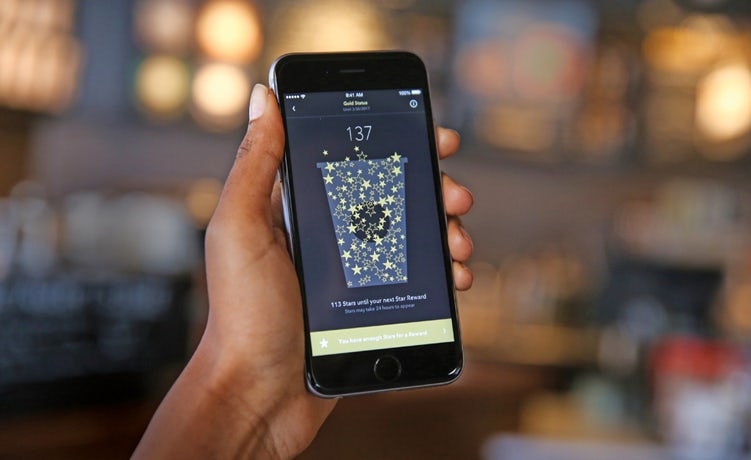
Starbucks says its heavy focus on technology is enabling it to embrace conversational commerce “very rapidly”, allowing consumers to order coffee at home or in their car using smart devices such as Amazon Echo.
Speaking at its annual meeting of Shareholders yesterday (22 March), the company’s chief technology officer Gerri Martin-Flickinger spoke about how the ways in which consumers are interacting with technology is radically changing. While young people currently “use one finger and point and click” to order, she predicts the next generation “won’t even do that” – and will use their voices instead.
Late last year, the coffee company announced it would be implementing voice ordering into its mobile app. So far, it has made the feature available to roughly 100,000 customers in the US, and it plans to roll it out nationwide by the end of the year. It is unknown when the feature will be made available to UK consumers.
Our technology foundation is allowing us to embrace conversational commerce very, very rapidly.
Gerri Martin-Flickinger, Starbucks
“As you can imagine, the opportunity for voice and other settings becomes quite intriguing. For example, we delivered and elect the skill that allows you to order coffee at home from your Amazon Echo. Our technology foundation is allowing us to embrace conversational commerce very, very rapidly,” she explained.
“It will be available in market later this year for customers with the Alexa Skills, and Ford with Sync 3. So, it only takes a little imagination to think about where conversational ordering will show up next.”

Digital gifting

The brand is also hoping to revive and update its Starbucks gift card system, which were traditionally available in-store and through other retailers. It also allows people to purchase the gift cards both online and through the app.
Consumers are now also able to send gift cards through social channels, with the brand planning to release Starbucks gifting through iMessage next month. This will allow customers to give a Starbucks gift card within an iMessage conversation on an iPhone or an iPad. The recipient can redeem the gift card right from their iPhone using Apple Pay.
Martin-Flickinger concluded: “We’ve many more social gifting solutions coming all with the intent of making gift giving and receiving even easier for our customers. The trends I’ve been talking about here today are not just US-centric. We’re driving towards these types of solutions all around the world.”

US jobs are being threatened by automation

Estimated Global Robot ShipmentsBI Intelligence

Thirty-eight percent of all jobs based in the US could be automated in the next 15 years, according to a recent study from PricewaterhouseCoopers (PwC) — the highest percentage of all the countries analyzed in the study.
Notably, the study found that it's not just lower-wage blue-collar positions that are at risk of being automated, but also a number of white-collar jobs, particularly in the transportation, retail, and financial services sectors.
Companies could be particularly interested in automating their US-based workforce as a result of high labor costs and numerous routine-centric jobs in the country. PwC points out that US jobs largely consist of white-collar workers who carry out routine tasks — such as back-office support roles — that robots or other technologies could be capable of executing soon. This, combined with the country’s high wages and standard of living relative to the rest of the world, make it an area that has a substantial number of jobs at risk".
Many other developed economies with large service sectors also have substantial jobs at risk:
  • Thirty percent of UK-based jobs are at risk of being automated. The UK also has a substantial financial services sector, though PwC observes that these jobs involve fewer routine tasks than those in the US.
  • In Germany, 35% of the labor market is threatened by automation. The report notes that Germany has a larger manufacturing sector than the UK, a sector that traditionally has been a prime target for automating tasks on assembly lines.
  • Twenty-one percent of jobs in Japan are at risk of being replaced in the next 15 years. However, PwC notes that a large percentage of Japanese-based jobs already are automated. As a result, there's much less room for growth in automation in the coming years.
While robots are already common in many industrial settings, they'll soon make their way into white-collar professions as well. The manufacturing sector has benefited from a very high ROI on industrial IoT solutions, making it the sector with the highest number of jobs lost to automation. But in the coming years, increasing numbers of white-collar jobs will also be at risk, according to PwC. This will pose problems for the larger economy that might be solved through workforce retraining programs, for example.
Businesses throughout the world are increasingly using robots to automate portions of their workflow.
Traditionally, robots have been used primarily in manufacturing. But other industries including healthcare, shipping and logistics, food services, retail, hospitality, and more are starting to also use robots. For example, hospitals are using robots to assist in surgery, retail stores are testing robots to take inventory, and warehouses are using robots help sort packages.

Whole Foods is facing its worst nightmare after an unexpected threat stole millions of customers

Whole FoodsReuters
WFM Whole Foods Mark
 28.53 -0.40 (-1.40 %)
DisclaimerGet real-time WFM charts here »
Whole Foods is losing millions of customers to what was once an unthinkable threat: Kroger.
The organic-food chain has lost as many as 14 million customers in the past six quarters, according to Barclays analyst Karen Short.
Most of those customers are instead going to Kroger and probably won't ever go back to Whole Foods, Short said in a recent research note.
"The magnitude of the traffic declines ... is staggering," Short said. "As most retailers know — once traffic has been lost, those patterns rarely reverse."
Kroger — a conventional grocer not known for organic offerings — has not historically been regarded as a significant threat to Whole Foods.
Whole FoodsBarclays
But in recent years Kroger has ramped up its supply of organic foods in a bid to steal market share from Whole Foods and other niche grocers such as Sprouts Farmers Market and Fresh Market. 
Kroger now devotes several aisles in its stores to organic and natural foods and offers a variety of organic meat and fresh produce. The chain has its own line of organic goods under the "Simple Truth" brand, and it's prices are about 15% cheaper than Whole Foods' prices, according to a study last year. 
The expansion into organics has paid off.
Kroger's sales of organic and natural food totalled $16 billion in the past year, compared to $15.8 billion at Whole Foods, according to Barclays.
Kroger Marketplace (62)A Kroger store in Richmond, Virginia.Business Insider
As Kroger's share of the organic-food market grows, Whole Foods' is shrinking.
Whole Foods' same-store sales fell 2.4% in 2016. That metric is expected to fall another 2.5% this year. Meanwhile, Kroger's same-store sales grew 1% in 2016.
Whole Foods CEO John Mackey recently acknowledged the growing threat from conventional grocers, without specifically naming Kroger.
"The more conventional mainstream supermarkets have upped their game," Mackey said on a call with analysts in February. "We're going to do the best job that we can to keep our core customers from migrating back over to those guys."
But according to Short, the Barclays analyst, there's not much Whole Foods can do to stop the shopper attrition.
"Whole Foods might face significant challenges to reverse behavioral changes even if execution improves because execution at competing retailers remains very strong," Short added.

Supermarkets keep shoppers guessing with nonfood items

Stores from Aldi to Cub to Hy-Vee surprise customers with furniture and freezers 
itemprop
GLEN STUBBE - STAR TRIBUNE
Wendy Rojas and her daughter Krystell, 15, shopped the produce section at the new Burnsville Aldi.
Consumers are finding more and more goodies to tempt them at the supermarket, but many of them aren’t even edible.
This week, Aldi reached into Ikea’s bag of tricks and offered an upholstered chair in a box for $70, an ottoman for $40 and leaning bookshelf for $40. Cub Foods is currently selling ­freezers for $199. Hy-Vee’s newest Twin Cities stores entice shoppers with departments devoted to cosmetics, clothing and wellness supplements.
With so many nonfood items crowding the shelves, consumers can find nearly everything under the sun at the supermarket.
They are gravitating toward the edge of store where meat, dairy, produce and delis are placed, but also nonfood categories, according to Alexia Howard at AllianceBernstein global investment firm. Meanwhile, the center store area with cans and boxed goods has shrunk. Why?
It’s about opportunistic buying, said Paco Underhill, environmental psychologist and the author of “Why We Buy: The Science of Shopping.”
“The internet has taught us opportunity — that we can buy anything from almost anywhere,” he said. “People used to think they would only buy milk at the grocery store or convenience store and now they’ll buy it at a drugstore or a hardware store.”
That’s causing supermarkets to look for new ways to attract shoppers. Retailers such as Aldi have learned if they can get an aggressively good price on a desirable item, consumers will buy it, even if it’s an oddball thrown into the regular mix.
Kirby and Barb Hunt of Burnsville look specifically for the nonfood items in Aldi’s weekly flier, and they are regulars in the discount chain’s home aisle. On opening day Thursday at the new Aldi across from Burnsville Center, the couple had a $20 waffle iron in their cart.
“This aisle has good finds,” Kirby Hunt said. “We’d buy that chair if we needed it.”
The element of surprise keeps shoppers coming back, said Dave Brennan, a retailing professor at the University of St. Thomas.
“The idea is to get people in the store more frequently and then keep them there longer,” he said. Just as Target and Wal-Mart added groceries to get people to shop more often, supermarkets are now adding general merchandise for the same reason.
Aldi runs two pages of nongrocery items called “Aldi Finds” in its weekly ad, and the selection keeps expanding.
“In years past we would not have carried furniture,” said Matt Lilla, vice president of the store’s Faribault division. “We’re finding that we can sell just about anything.”
Aldi’s new, larger-scale Burnsville store — which at 12,000 square feet is a fraction of a 90,000-square-foot Hy-Vee — devotes an entire aisle to such home goods rugs, pillows, shelving, mattress pads, office chairs, writing desks, bookshelves and small ­appliances.
It’s a little bit like throwing things against the wall to see what sticks, said David Livingston, supermarket analyst in Milwaukee.
“They’re experimenting, trial and error, to see what works,” he said. “Aldi introduced Lacura cosmetics and that didn’t work so well, so they brought in a baby ­section.”
Groceries have always had a relatively low profit margin, especially in stores’ center aisles filled with cans and cartons of food. “Items that can spend five years on the shelf have the lowest gross margin,” Livingston said. “That’s why supermarkets want to steer them to higher-profit items.”
For the past two years, Cub Foods has run a promotion offering a freezer for $199. Customers also get a $50 gift card with the purchase.
“The freezer promotion is something Cub customers have enjoyed so we will continue to look for these out-of-the-box opportunities as they become available in the future,” said Mike Wilken, spokesman for Supervalu, Cub’s owner.
While buying a low-priced freezer at the supermarket might not seem as knee-jerk as snatching a bag of Dove chocolates off the shelf, they are both considered impulse buys at the supermarket.
“Consumers spending more per trip offsets lower traffic at the retailer,” said Brennan, the St. Thomas professor.